What Is WPC Plywood and Is It Waterproof?

Time:2026-09-09 Author:Sophia
0%

WPC Plywood is often presented as a modern answer to moisture problems. It combines wood fibers with thermoplastics, additives, and manufacturing pressure. The result can resemble plywood, but its internal structure differs. That difference matters when water reaches cut edges, screw holes, or exposed surfaces.

Dr. Michael P. Wolcott, a recognized wood-plastic composite researcher at Washington State University, notes, “WPC performance depends on formulation, processing, and the end-use environment.” This statement deserves attention. A dense WPC Plywood panel may resist rain, splashes, and humid air better than ordinary plywood. However, water resistance is not the same as complete waterproofing. Some products absorb little water across their faces but swell near unsealed edges. Poorly protected fastener holes can also invite moisture.

Real conditions reveal the truth. Imagine a panel beneath an outdoor sink, with water collecting around one screw. The surface may look unchanged for months. The hidden edge could still soften, stain, or lose strength. That is the uncomfortable detail many product descriptions overlook. Not every WPC Plywood panel uses the same resin, fiber ratio, surface treatment, or pressing method. Performance varies.

This guide will examine how WPC Plywood is made, where it performs well, and when caution is necessary. It will compare water resistance with waterproof performance. It will also consider sealing, drainage, installation, and manufacturer testing. The label alone is insufficient. Check technical data. Ask about thickness swelling, water absorption, and intended exposure. In practice, careful installation can matter as much as the panel itself. Sometimes, the simple answer fails.
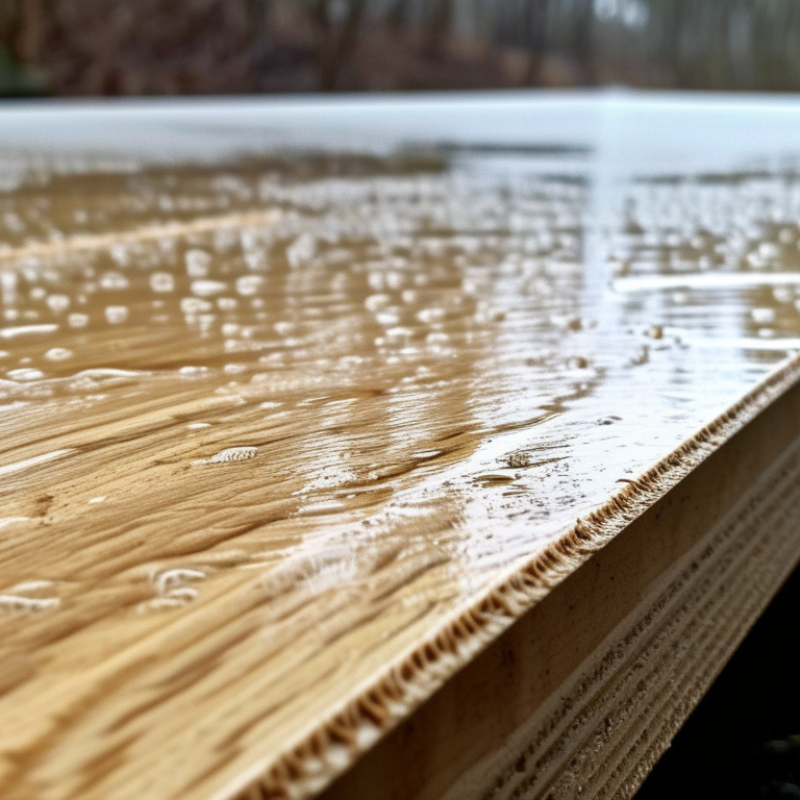
What Is WPC Plywood and Is It Waterproof?

WPC Plywood: Definition, Composition, and Key Characteristics

WPC Plywood: Definition, Composition, and Key Characteristics

WPC plywood is a wood-plastic composite panel made from wood fibers, thermoplastic resin, and selected additives. Unlike traditional plywood, it does not always contain thin wood veneers bonded in layers. The word “plywood” can therefore be slightly misleading. Its structure depends on the manufacturer’s forming process.

Wood fibers provide stiffness and a familiar timber-like appearance. The plastic component improves moisture resistance and dimensional stability. Additives may support color retention, processing, fire performance, or resistance to insects. However, these properties vary between formulations. A reliable specification should state the resin type, density, thickness tolerance, and test results.

WPC panels generally absorb less water than ordinary wood-based boards. That makes them useful for humid rooms, outdoor furniture, wall cladding, and other moisture-prone applications. They are not automatically waterproof. Water can enter through cut edges, screw holes, joints, or damaged surfaces. I would seal exposed edges and allow drainage behind the panel. Small installation details matter.

The panel may swell less.

It still needs correct support.

Before installation, check the product’s water absorption data and intended-use rating. Also inspect how it reacts to heat, because plastic-rich boards can expand in direct sunlight. A common mistake is treating moisture resistance as complete protection. That assumption deserves reconsideration, especially near standing water or poorly ventilated walls.

How WPC Plywood Is Manufactured and Classified

WPC plywood is made by combining wood fibers or flour with thermoplastic polymers and selected additives. Unlike ordinary plywood, it is formed through mixing, heating, and pressing rather than cross-laminating thin wood veneers. The blend is heated until the polymer softens. It then enters a mold or press, where pressure creates a stable board. Cooling controls its final thickness and shape.

Manufacturers usually classify WPC plywood by composition, density, surface finish, and intended use. A higher wood content can improve stiffness and natural texture, while more polymer often improves moisture resistance. Some boards have smooth faces for cabinets, while others receive textured surfaces for wall panels or outdoor furniture. Density also matters. A dense sheet feels heavier and resists dents better, but it may be harder to cut on site.

In practical installation, WPC plywood handles splashes better than many untreated wood boards. It does not automatically mean waterproof. Water can still enter through cut edges, screw holes, or poorly sealed joints. I recommend checking the technical sheet and testing a small offcut before installation. This is especially important near sinks, balconies, and humid storage rooms. Classification labels can vary between manufacturers, which creates confusion. A board marked for exterior use may still require edge sealing and proper drainage. That detail is easy to miss.

Water Resistance and Waterproof Performance of WPC Plywood

WPC plywood combines wood fibers with thermoplastic resin, creating a dense panel with lower moisture absorption than ordinary plywood. Its water resistance comes mainly from the polymer matrix and sealed edges. It is not automatically waterproof.

Published laboratory studies commonly report 24-hour thickness swelling of about 1–5% for well-made WPC panels. Conventional plywood may show roughly 6–15% under similar immersion conditions. Results vary with resin content, fiber type, pressing pressure, and surface quality. These figures should guide comparison, not replace a product test report.

The USDA Wood Handbook explains that water absorption remains strongly affected by exposed end grain and imperfect joints. ASTM D1037 provides widely used procedures for measuring water absorption, thickness swelling, and dimensional change in wood-based panels. In practical installation, an unsealed cut edge can absorb water like a narrow sponge. That detail matters.

I would not call WPC plywood waterproof by default. It may perform well in kitchens, bathrooms, wall cladding, and damp storage areas. Continuous immersion is different. A 2024 industry review of composite panels also notes that long-term cycling between wet and dry conditions can weaken interfaces, even when initial swelling is low. The weak point is often the joint. Seal cut edges, protect fasteners, and request immersion data before specifying panels for outdoor or high-humidity use. Temperature effects are sometimes overlooked. That deserves more testing.

What Is WPC Plywood and Is It Waterproof?

Typical 24-hour water absorption comparison

WPC plywood is a wood–plastic composite panel made from wood fibers or flour combined with thermoplastic polymers. Its plastic content gives it substantially lower moisture absorption than conventional wood-based panels. However, WPC plywood should not automatically be considered completely waterproof: exposed edges, joints, fastener holes, prolonged immersion, temperature changes, and product formulation can affect its performance. The values shown are typical industry ranges and may vary according to density, resin type, surface treatment, and test method.

Lower water absorption generally indicates better resistance to moisture-related swelling.

Advantages and Limitations of WPC Plywood in Construction

WPC plywood combines wood fibers with thermoplastics, producing a dense panel with lower water uptake than conventional plywood. It is water-resistant, not automatically waterproof. In practical use, an unsealed cut edge can still absorb moisture, swell, or develop staining. The USDA Forest Products Laboratory reports that wood commonly reaches about 12% moisture content at 20°C and 65% relative humidity. WPC reduces this moisture response, but it does not eliminate it.

Its advantages are clear in humid interiors, kitchens, wall cladding, and temporary formwork. It does not support fungal growth as easily as untreated wood, and its smooth surface simplifies cleaning. Market evidence also shows rising construction interest. Grand View Research estimated the global WPC market at roughly US$7 billion in 2023, with annual growth above 7% through the decade. That growth reflects practical demand, not proof of universal structural performance.

Limitations deserve equal attention. WPC panels can expand with heat, creep under sustained loads, and lose color under ultraviolet exposure. Screw holding may also be weaker than expected, especially near edges. I would not specify WPC plywood for beams or primary load-bearing floors without certified test results. ASTM D570 water-absorption testing and ASTM D1037 panel testing can guide comparisons, but results depend on formulation and thickness. A real site trial is still valuable. One overlooked weakness remains fire behavior; check the required classification before installation.

Choosing, Installing, and Maintaining WPC Plywood Properly

WPC plywood combines wood fibers with thermoplastic polymers, but “waterproof” can be misleading. Moisture resistance depends on the resin ratio, fiber treatment, surface finish, and edge sealing. The USDA Forest Products Laboratory notes that wood-based materials still expand and contract with humidity changes. WPC panels are more stable than ordinary plywood, yet they are not immune to movement.

Choose panels with documented thickness-swelling and water-absorption results. ASTM D1037 provides recognized test methods for these properties, but it does not automatically certify a panel as waterproof. Check the technical sheet before using it for bathroom cabinets, outdoor furniture, or wet-area walls. Leave small expansion gaps, support the panel evenly, and seal cut edges with a compatible coating. Poorly sealed edges can absorb water first.

Tips: Keep the panel off standing water. Use corrosion-resistant fasteners. Seal every cut.

During installation, avoid forcing tight joints. A small gap may look imperfect, but it allows seasonal movement. Clean the surface with mild soap and water, then dry it fully. Avoid abrasive tools and harsh solvents. Inspect joints twice yearly, especially near sinks, decks, and exposed corners. The 2023 International Building Code moisture guidance also emphasizes drainage and ventilation around water-exposed assemblies. WPC can perform well, but installation mistakes often decide its lifespan.

What Is WPC Plywood and Is It Waterproof? - Choosing, Installing, and Maintaining WPC Plywood Properly
Data Dimension Typical Information Practical Meaning
Material definition Wood-plastic composite sheet made from wood fibers or flour, thermoplastic resin, and additives. It is an engineered composite panel rather than conventional plywood made from bonded wood veneers.
Common polymer types Polyvinyl chloride (PVC), polyethylene (PE), and polypropylene (PP) are commonly used thermoplastics. The resin type affects moisture resistance, stiffness, weight, heat behavior, and fastening performance.
Typical thicknesses Common panel thicknesses include approximately 3, 5, 8, 12, 15, 18, and 25 mm. Select thickness according to span, load, screw-holding requirements, and whether the panel is used horizontally or vertically.
Typical sheet size Many suppliers produce sheets around 1,220 × 2,440 mm, although actual sizes vary by manufacturer and production line. Confirm sheet dimensions before designing cabinetry, wall panels, or cutting layouts.
Density Approximately 0.60–1.50 g/cm³, depending on polymer content, fillers, foaming, and manufacturing method. Higher-density panels are generally more rigid, while lower-density boards are lighter but may need closer support spacing.
Water resistance WPC panels normally resist liquid-water absorption better than untreated wood-based panels because the polymer matrix limits moisture penetration. Suitable for damp environments when properly specified, sealed, supported, and installed.
Is it waterproof? Not automatically. “Water-resistant” describes reduced water uptake; “waterproof” requires verified performance for a defined application and exposure period. Do not rely on the panel alone for a shower enclosure, roof, boat, or continuously submerged installation. Use a complete waterproofing system where required.
Dimensional movement Thermoplastics expand and contract with temperature changes more noticeably than dry wood; the exact coefficient depends on the formulation. Leave the clearance specified by the supplier, especially at panel edges, joints, and long uninterrupted runs.
Rot and fungal resistance The reduced moisture uptake can improve resistance to rot and fungal deterioration compared with untreated wood, but the result depends on formulation and exposure. Keep joints, edges, and surrounding structures from trapping water; poor drainage can still damage adjacent materials.
Typical applications Bathroom and kitchen cabinetry, wall cladding, partitions, furniture components, utility rooms, and other humid interior areas. Use only products rated for the intended indoor, outdoor, structural, or high-temperature application.
Load-bearing use Many WPC sheets are non-structural or decorative panels; load capacity varies significantly by thickness, span, support, and composition. Do not substitute WPC plywood for structural plywood without verified engineering data and applicable approvals.
Cutting and drilling Use sharp, carbide-tipped woodworking blades and drills; support the sheet to reduce vibration, chipping, and heat buildup. Slow, controlled cutting and adequate ventilation help produce cleaner edges and reduce melting caused by friction.
Fastening method Corrosion-resistant screws, washers, inserts, or suitable adhesives may be used depending on the panel and application. Pre-drilling is often advisable near edges. Avoid over-tightening, which can crush or deform the panel.
Support spacing There is no universal spacing value; it depends on panel thickness, load, orientation, and the manufacturer’s tested span tables. Use closer supports for thin panels, heavy loads, shelves, countertops, and areas subject to impact.
Edge treatment Cut edges may be more exposed to moisture, dirt, impact, and dimensional movement than finished faces. Use compatible edge banding, sealant, trim, or a finishing profile when the edge will be visible or exposed.
Surface finishing Some WPC surfaces are factory-finished, while others can accept laminates, films, paint, or coatings only after surface preparation and compatibility testing. Test adhesion on an off-cut before applying a finish to the complete installation.
Cleaning routine Use a soft cloth or sponge with warm water and a mild, non-abrasive detergent. Remove standing water and chemical residues promptly to protect the surface and nearby joints.
Avoid during maintenance Avoid abrasive pads, harsh solvents, uncontrolled high heat, and chlorine-based or acidic cleaners unless specifically approved. Aggressive cleaning may scratch, discolor, soften, or weaken the surface finish.
Inspection frequency Inspect exposed installations at least twice a year and after unusual flooding, impact, or severe temperature changes. Check fasteners, joints, edges, sealants, warping, stains, and areas where water may collect.
Storage before installation Store sheets flat on level supports, protected from direct sunlight, rain, dirt, and excessive heat. Allow the material to acclimate according to the supplier’s instructions and prevent unsupported overhangs that may cause bending.
Important specification note: WPC plywood properties vary widely by resin type, wood-fiber content, density, additives, surface treatment, and manufacturing process. Before purchase or installation, request the product’s technical data sheet, water-absorption test method, fire classification, mechanical properties, temperature limits, and application approvals.

FAQS

: What is WPC plywood?

: WPC plywood is a composite panel made from wood fibers, thermoplastic resin, and selected additives. It may not contain layered wood veneers. The name can be slightly misleading.

What benefits does WPC plywood offer?

It usually absorbs less water than ordinary wood-based boards. It also provides a smooth, timber-like surface that is easy to clean. This suits humid rooms, wall cladding, and outdoor furniture.

Is WPC plywood completely waterproof?

No, it is generally water-resistant rather than fully waterproof. Moisture can enter through cut edges, screw holes, joints, or damaged surfaces. Seal exposed edges carefully.

Where can WPC plywood be used?

Common uses include kitchen panels, bathroom cabinets, outdoor furniture, and temporary formwork. It may also suit moisture-prone wall cladding. Avoid standing water.

What limitations should users consider?

WPC panels may expand in direct sunlight and creep under sustained loads. Ultraviolet exposure can cause color fading. Screw holding may weaken near edges.

Can WPC plywood support heavy structural loads?

Do not assume it can replace beams or primary flooring. Check certified load data, panel thickness, and support spacing. A small site trial may reveal problems earlier.

How should WPC plywood be installed?

Support the panel evenly and leave small expansion gaps. Seal every cut edge with a compatible coating. Use corrosion-resistant fasteners and provide drainage behind the panel.

How should WPC plywood be maintained?

Clean it with mild soap and water, then dry the surface fully. Avoid abrasive tools and harsh solvents. Inspect joints twice yearly near sinks, decks, and exposed corners.

What specifications should buyers check?

Review resin type, density, thickness tolerance, water absorption, and thickness swelling. Also check heat movement, fire classification, and intended-use ratings. Some product claims remain too vague. Reflect on them.

Conclusion

Wpc Plywood is a composite panel made by combining wood fibers, plastic polymers, and selected additives to create a stable, low-maintenance building material. Its composition gives it a uniform surface, good dimensional stability, resistance to insects, and reduced sensitivity to moisture compared with conventional plywood. Manufacturing methods and material ratios can vary, so Wpc Plywood may be classified according to density, surface finish, intended application, and structural performance.

Wpc Plywood offers strong water resistance and can perform well in damp areas, but it should not automatically be considered completely waterproof in every situation. Prolonged immersion, exposed edges, poor sealing, or incorrect installation may still cause damage. Its advantages include easy cleaning, durability, and reduced maintenance, while limitations may include weight, expansion from temperature changes, and lower suitability for certain load-bearing uses. Proper selection, sealed joints, suitable fasteners, ventilation, and regular inspection are essential for reliable installation and long service life.


Sophia

Sophia

Sophia is a dedicated marketing professional with an exceptional depth of knowledge about her company's products and services. With a keen understanding of market trends and customer needs, she crafts insightful blog posts that not only inform but also engage readers, enriching the company’s online......