Outdoor living spaces are changing, and Wpc Decking Panel is becoming a practical alternative to traditional timber. Grand View Research reported that the global wood-plastic composites market was valued at approximately USD 7.3 billion in 2023. Its analysis also expects continued growth through 2030. This expansion reflects demand for lower-maintenance outdoor materials, not just attractive garden design.
A Wpc Decking Panel combines wood fibers with thermoplastics, pigments, and stabilizers. The exact formula varies between manufacturers. That detail matters. A board installed beside a sunny pool faces different stress than one placed under a covered balcony. Moisture, ultraviolet exposure, temperature changes, foot traffic, and poor drainage can all influence service life. It may look solid on day one.
Industry standards help separate marketing claims from measurable performance. ASTM D7031 provides guidance for evaluating wood-plastic composite materials, while ASTM D7032 addresses performance requirements for plastic lumber used in structural applications. These standards do not guarantee that every deck will last for decades. They provide a technical framework for testing strength, weathering, and safety.
Industry reports often describe WPC as durable, moisture-resistant, and easier to maintain than untreated wood. Those advantages are real, but they are not absolute. Surface fading can occur. Scratches may be difficult to repair. Heat can also build beneath dark boards during summer afternoons. Therefore, this guide examines composition, durability evidence, installation conditions, and long-term maintenance. The honest answer is more useful than a perfect promise: Wpc Decking Panel can perform well, but only when product quality and installation practice match the environment.
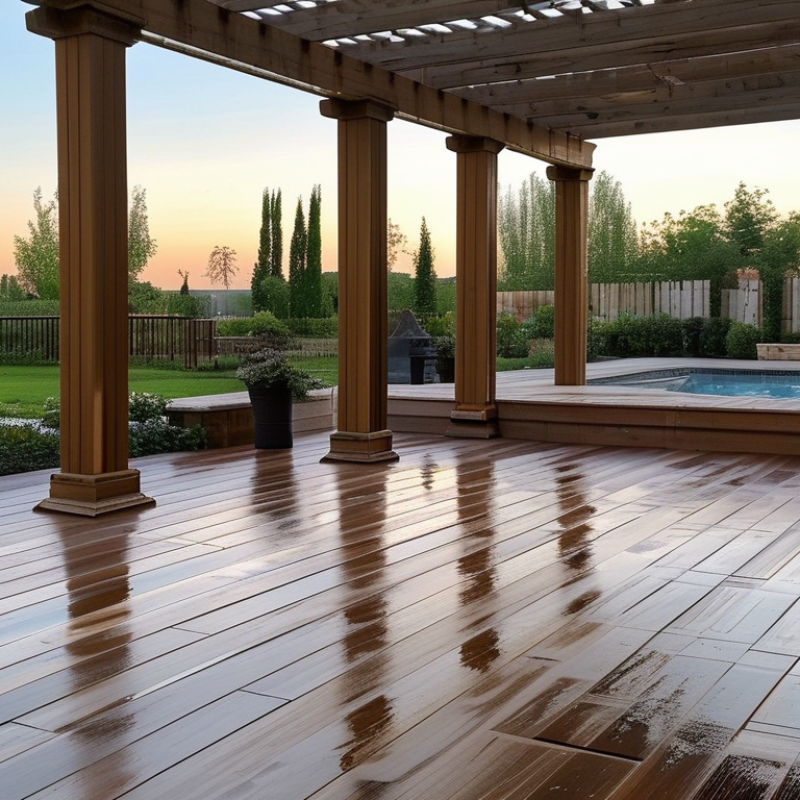
WPC decking panels are made from 50–70% wood fiber and 30–50% polymer. That ratio matters. Wood fiber adds texture, stiffness, and a warmer appearance. Polymer binds the fibers and improves resistance to moisture, insects, and surface cracking. Some formulas also include pigments, stabilizers, and coupling agents. Therefore, two panels with similar percentages may perform differently.
In practical inspections, WPC decking usually handles rain better than untreated timber. It does not readily rot, but it is not waterproof in every situation. Water can still enter through cut edges, screw holes, or poorly sealed joints. Proper spacing underneath allows air movement and helps drainage. The boards also expand and contract with temperature changes. Ignoring this detail can cause raised edges or buckling.
I would not call WPC decking maintenance-free. That phrase sounds convenient, but it is misleading. The surface may collect dust, grease, and algae, especially beneath shaded furniture. Regular sweeping and gentle washing usually help. Avoid harsh tools that scratch the polymer surface. Darker boards can become hot under strong sunlight, while lighter colors may show stains more clearly. The most durable result depends on the material blend, installation quality, drainage, and local climate. Percentages explain the structure, but they do not tell the entire story.
| Data Dimension | Typical Information | What It Means for Durability |
|---|---|---|
| Basic Definition | Wood–plastic composite decking made from wood fiber or flour blended with a thermoplastic polymer and processing additives. | The polymer helps protect the wood component from moisture, while the wood fiber contributes stiffness and a natural appearance. |
| Wood Fiber Content | Approximately 50–70% by formulation, depending on the product and manufacturing process. | Higher wood content can increase stiffness and a wood-like feel, but it may also increase sensitivity to moisture and dimensional movement. |
| Polymer Content | Approximately 30–50% by formulation. Common matrix polymers include polyethylene, polypropylene, and polyvinyl chloride. | The polymer binds the wood particles and improves resistance to water absorption, decay, and routine outdoor exposure. |
| Moisture Resistance | Generally higher than untreated solid wood because the plastic matrix reduces direct water access to wood fibers. | It is less likely to rot or absorb water rapidly, but unsealed cut ends, gaps, and poor drainage can still allow moisture-related damage. |
| Resistance to Rot and Insects | Typically resistant to fungal decay and less attractive to wood-boring insects than untreated wood. | This can extend service life in damp outdoor settings, although prolonged wet conditions and biological growth on the surface should still be avoided. |
| Dimensional Movement | WPC boards expand and contract with temperature; moisture movement varies with composition and construction. | Correct joist spacing, fastener placement, end gaps, and ventilation are essential to prevent buckling or excessive gaps. |
| UV and Color Stability | Outdoor exposure can cause gradual fading or surface weathering. UV stabilizers and capped surfaces can reduce, but not always eliminate, this effect. | Color change is usually an appearance issue rather than a structural failure, but performance depends on formulation and climate. |
| Slip Performance | Varies according to surface texture, wear, contamination, and wet conditions. | Textured surfaces and regular cleaning can improve footing, but no decking surface should be assumed to be slip-proof. |
| Maintenance Requirement | Usually requires sweeping and periodic washing with suitable soap and water; paint, stain, or sealing is often not required. | Lower routine maintenance can reduce long-term upkeep, but spills, leaves, algae, and standing water should be removed promptly. |
| Scratch and Impact Resistance | Moderate and product-dependent. Heavy furniture, dragging objects, sharp tools, and abrasive cleaning can mark the surface. | Protective pads, careful handling, and compliance with cleaning instructions help preserve the finish. |
| Structural Support | Deck boards are typically installed over a properly designed substructure; the board itself is not a substitute for structural joists. | Incorrect joist spacing or inadequate support can cause deflection and premature failure even when the board material is durable. |
| Fire Performance | WPC is combustible, and fire behavior differs by polymer, additives, profile, and installation system. | Fire-rating requirements should be checked against applicable local building codes and independent test reports. |
| Typical Service-Life Expectation | Often designed for several decades of outdoor use, but actual service life varies with formulation, climate, installation, loading, and maintenance. | A precise lifespan should be based on tested product data, installation requirements, and the exposure conditions of the project. |
| Overall Durability Assessment | WPC decking is generally durable for residential and many light-commercial outdoor applications when correctly specified and installed. | Its main advantages are moisture and decay resistance with relatively low maintenance; its main limitations are heat, fading, scratching, movement, and installation sensitivity. |
Note: The figures and performance descriptions are typical industry ranges and general characteristics. The exact composition, loading capacity, fire behavior, color stability, and warranty period must be verified in the technical documentation for the specific WPC decking system.
WPC decking combines dried wood fibers, thermoplastic polymers, stabilizers, and colorants. Moisture must remain low.
The blended material enters an extruder. Heat and pressure push it through a shaped die.
Cooling calibrators control the panel’s width, thickness, and flatness. Uneven cooling may create slight texture differences.
A protective outer skin can improve resistance to stains, fading, moisture, and everyday scratches. It is not indestructible.
Review water absorption, slip resistance, fastener guidance, temperature limits, and tested support spacing.
Check the cut edges for solid bonding between the core and outer layer. Look for bubbles or weak areas.
No. Performance testing provides useful evidence, but unsuitable design or careless workmanship can still create problems.
Use suitable expansion gaps, correct fasteners, proper joist spacing, and reliable drainage. Trapped water causes trouble.
It examines load performance, flexural strength, stiffness, fastener holding, water absorption, and dimensional changes.
Clean oil and dark drink spills early. Inspect fasteners, board ends, gaps, and drainage regularly. Small shortcuts can become expensive.
A Wpc Decking Panel is a composite outdoor decking material made by combining approximately 50–70% wood fiber with 30–50% polymer. This balanced composition provides a natural wood-like appearance while improving resistance to moisture and everyday outdoor wear. During production, the wood fiber and polymer are carefully mixed, shaped through extrusion, and often finished with a protective surface cap. This process helps create consistent dimensions, enhanced protection, and easier maintenance.
The durability of WPC decking depends on its material quality, construction, and installation. It is generally resistant to moisture, rot, insects, ultraviolet exposure, and repeated freeze–thaw cycles, making it suitable for many outdoor environments. Structural decking products should also be evaluated through recognized testing, including ASTM D7032, to assess safety and performance. With proper installation and routine care, high-quality WPC decking can provide an expected service life of approximately 25–30 years.

 Yida Wood