Choosing a Wpc Floor Panel in China takes more than comparing prices or surface colors. A convincing sample may resemble oak, yet the panel’s core, locking profile, and finish determine how it performs under daily use. Look closely at the edges. Check whether the joints fit evenly, and ask for product specifications covering dimensions, wear layer, and installation conditions.
One point matters: no source article or verified expert quotation was provided, so attributing a statement to a named specialist would risk inventing a quote. A useful selection principle is simple: “Judge the panel by its documented construction and tested performance, not appearance alone.” Treat that as editorial guidance, not a quotation from a named expert.
For buyers evaluating China-made options, request samples from the actual production range, not just a polished showroom board. Compare the surface in daylight. Press the locking edges together, then inspect them for gaps or damage. Ask suppliers how they manage batch consistency and what care the finish requires. Clear, specific answers are more useful than broad claims such as “waterproof” or “premium.”
Specifications do not tell the whole story. Installation quality, subfloor preparation, and room conditions can change the result. Even a well-made panel can disappoint when fitted poorly. This guide will help readers assess construction, compare claims, and choose a Wpc Floor Panel suited to the space. One caution remains: marketing language is not proof.
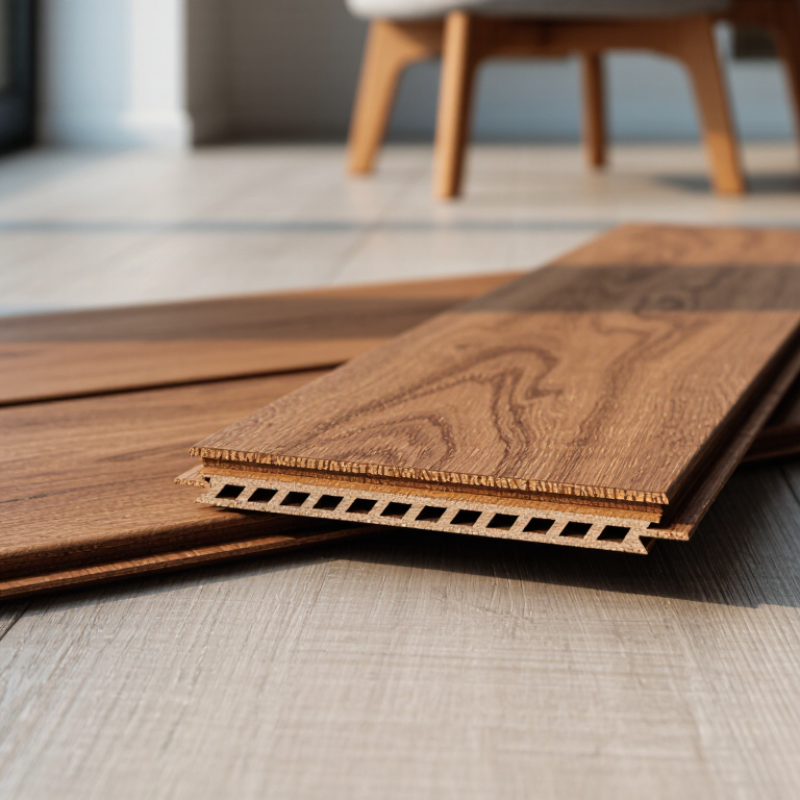
A WPC floor panel is usually built in layers. A clear wear layer protects the printed décor film, while a wood-plastic composite core provides rigidity. Some products include an attached backing pad. Check a cut edge: the layers should look even, with no obvious gaps or crumbling. Small details matter.
ASTM F3261 covers resilient flooring in modular form with a rigid polymeric core. Its requirements help assess product performance, but the term “WPC” alone does not prove a panel meets the standard. Ask for a technical data sheet and test documentation that identify the applicable classification and tested product. Compare those records with the panel’s thickness, locking profile, and intended use.
A thicker core is not automatically a better floor. Wear-layer thickness, joint design, installation conditions, and subfloor flatness also affect service life. In a showroom, inspect several panels under bright light and press gently around the edges. Minor visual variation may occur, but uneven joints deserve attention. I would not choose by a single number; product documents can be incomplete, so confirm that the test information matches the exact construction being sold.
For China best WPC floor panels, compare the wear layer before judging appearance or price. One mil equals 0.001 inch, so a 12-mil layer is 0.012 inch thick. Residential rooms with light foot traffic may suit 12 mil; busy homes often benefit from 20 mil. For shops, offices, or corridors, 20–22 mil is a more cautious starting point. These are practical selection ranges, not guaranteed service-life ratings.
ASTM F3261, the standard for resilient flooring panels, provides test and classification requirements; it does not promise that a particular mil thickness will last a set number of years. Ask suppliers for the product’s test documentation, wear-layer measurement, and installation guidance. A thicker layer can improve resistance to scuffs, but it cannot compensate for poor joints, uneven subfloors, or grit tracked in from outside. Tiny stones matter.
Check sample panels under strong light. Look for a clearly stated wear-layer thickness, not just “commercial grade.” Also compare warranty terms and cleaning instructions, since both affect real-world performance. One detail is easy to overlook: mils measure thickness, not the quality of the coating itself. A 20-mil layer may still disappoint if its finish or manufacturing consistency is weak. Industry specifications help narrow the choice, but they are not a substitute for product-specific test results.
| Application | Typical Wear-Layer Range | Equivalent Thickness | Expected Traffic | What to Check When Choosing |
|---|---|---|---|---|
| Low-traffic residential | 6–8 mil | 0.15–0.20 mm | Bedrooms and lightly used rooms | Review the manufacturer’s stated wear-layer measurement, warranty conditions, and care instructions. |
| Typical residential | 12 mil | 0.30 mm | Living rooms, dining areas, and most household spaces | Check that the product is rated for residential use and that the warranty covers the intended installation area. |
| Busy residential | 20 mil | 0.50 mm | Entryways, kitchens, and homes with children or pets | Compare scratch and stain test information, surface texture, and maintenance requirements; thickness alone does not establish performance. |
| Light commercial | 20 mil or more | 0.50 mm or more | Small offices, boutiques, and other limited-traffic settings | Confirm the commercial-use rating and warranty terms, including any limits for rolling loads or frequent cleaning. |
| Moderate commercial | 28–30 mil | 0.71–0.76 mm | Busier offices, hospitality areas, and retail spaces | Request product-specific test data and installation guidance; verify suitability for expected foot traffic and cleaning methods. |
Dimensional stability matters when choosing WPC floor panels, especially in rooms with sunny windows or changing temperatures. ASTM F2199 measures dimensional changes in resilient flooring after controlled heat exposure. A laboratory records how much a sample expands or contracts. Smaller changes can indicate better resistance to heat-related movement, but results need context. Check that the test method and product construction are suitable for the flooring being assessed.
Ask for the full test report, not just a passing claim. Look for the tested sample’s thickness, conditioning details, exposure temperature, and measured change. Compare results only when testing conditions match. A panel that stays stable in a lab may still move if installed over an uneven subfloor or without the required expansion gaps. Real rooms are messier. One overlooked detail can matter.
Tips: Review the report date and confirm it covers the exact panel construction you plan to buy. Ask how edges and joints were evaluated. ASTM F2199 focuses on dimensional change, not every aspect of floor performance, such as wear or impact resistance. Use it as one useful check, not the whole decision. Test reports can be imperfect, too; clarify unclear methods before relying on a single number.
China Best WPC Floor Panels: How to Choose Quality Options?
When comparing WPC floor panels, look beyond wear layers and surface texture. Ask for emissions results based on CDPH Standard Method v1.2, a chamber-testing method used to assess indoor emissions from building materials. Check that the report identifies the exact product tested, including its core, finish, and relevant installation materials. Similar-looking panels may not share the same results.
Review the report’s test conditions, sampling details, and reported emission levels. A clear, current report from a qualified laboratory is more useful than a general “low-VOC” claim. Pay attention to formaldehyde and other listed compounds, and confirm how results compare with the applicable criteria. Numbers need context.
At the showroom, the panels may have little noticeable odor. That does not prove low emissions; smell is an unreliable test. Request documentation before ordering, especially for bedrooms or smaller rooms with limited ventilation. One detail is easy to miss: adhesive, underlayment, and installation choices can also affect indoor air quality. Check those separately, and keep the records with your project files.
When comparing China-made WPC floor panels, ask for wet DCOF results—not just a “slip-resistant” label. ANSI A326.3 provides a test method for measuring dynamic coefficient of friction on hard flooring surfaces. The Tile Council of North America explains that a DCOF value of 0.42 is the reference criterion for many level interior areas expected to be walked on when wet. It is not a guarantee against slipping. Footwear, soap, dust, and floor slope can change real-world performance.
Request the report for the exact panel surface and finish you plan to buy. Check the test method, sample conditioning, measured result, and laboratory details. A glossy sample may behave differently from a textured one. Ask whether testing used the finished wear layer, not a similar material. Small details matter. If a supplier gives only a general certificate, request the underlying report and confirm its date. ANSI A326.3 results help compare products, but they do not settle every use case; kitchens, entryways, and wet rooms face different conditions. One number is useful, but incomplete. A practical evaluation should pair documented test results with a sample inspection and clear installation guidance.
Most panels contain a wear layer, printed décor film, and rigid composite core. Some include attached backing. Inspect the cut edge.
Look for even layers without gaps, crumbling, or loose sections. Press gently around the edges under bright light. Small defects matter.
No. Wear-layer thickness, joint design, subfloor flatness, and installation conditions also affect durability. One number cannot decide everything.
Request a technical data sheet and test reports for the exact panel. Check its thickness, locking profile, finish, and intended use.
Ask for chamber-test results using CDPH Standard Method v1.2. The report should identify the tested core, finish, and installation materials.
No. Odor is unreliable. Review formaldehyde and other reported compounds, then compare results with applicable criteria.
Yes. Adhesive, underlayment, and installation products may add emissions. Check their documentation separately, especially in bedrooms or small rooms.
ANSI A326.3 measures dynamic friction on hard flooring surfaces. A reported value helps comparison, but it does not guarantee slip prevention.
Confirm the exact surface, finish, test method, sample conditioning, result, laboratory, and report date. A general certificate may be incomplete.
Combine test results with sample inspection and installation guidance. Footwear, soap, dust, and slope can change actual performance. One number is incomplete.
Choosing a quality Wpc Floor Panel starts with understanding how it is constructed and how its classification under ASTM F3261 relates to the intended application. Compare wear-layer thickness, measured in mils, with expected foot traffic: residential spaces may need different protection from busy commercial areas. Rather than relying on appearance alone, consider whether the panel’s construction and wear layer suit the demands of the room.
Review test documentation before making a decision. ASTM F2199 results can help assess dimensional stability as conditions change, while emissions testing using CDPH Standard Method v1.2 provides information about VOC emissions. For areas where wet floors are a concern, check wet slip-resistance results from the ANSI A326.3 DCOF test. Together, these details offer a practical basis for comparing options and selecting a panel that fits the space, performance needs, and indoor environment.

Yida Wood